Memocept Official Website › Blog › Why Citrulline Is In Here
Why a Memory Formula Contains Citrulline and Arginine
Open the Memocept panel expecting ginkgo and you will find amino acids instead. The reasoning is circulation, not neurochemistry — and it is worth understanding, because it is also the honest limit of what this product can claim.
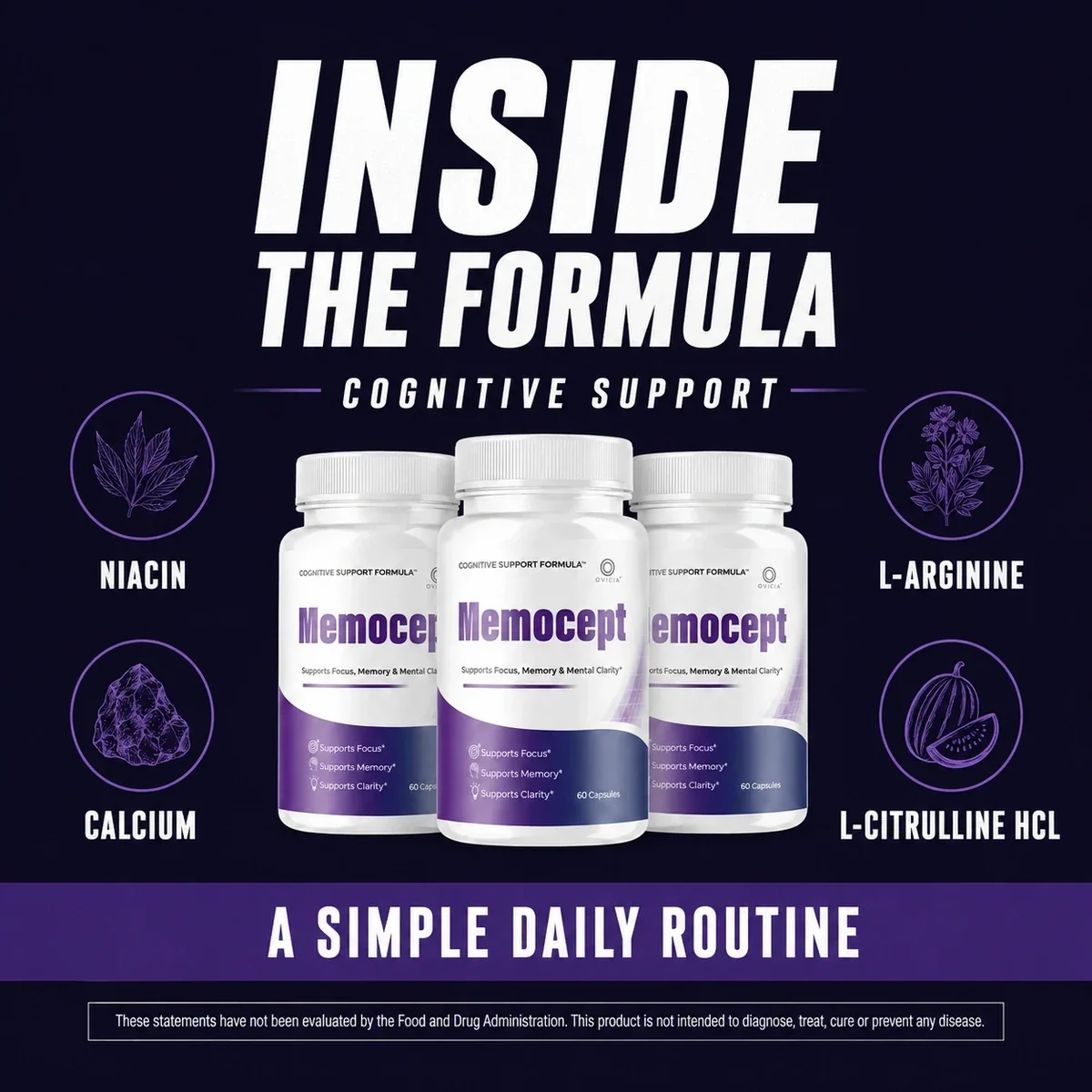
- The theory is blood flow. Arginine and citrulline feed the nitric-oxide pathway that relaxes blood vessels.
- Citrulline raises arginine better than arginine does — a genuine pharmacokinetic finding, and the reason both are on the label.
- The evidence is about circulation, not memory. That step is a reasonable hypothesis, not a proven chain.
- Amounts are not published for any of them, which limits how far you can take any of this.
This is general information, not medical advice. Memocept is a dietary supplement. It is not a treatment for Alzheimer’s disease, dementia or any other cognitive condition, and it is not a substitute for prescribed medication. New or worsening memory problems are a reason to see a doctor, not a reason to buy a supplement.
The pathway, in plain English
Your body makes nitric oxide, a signalling molecule that tells the smooth muscle in blood vessel walls to relax. Relaxed vessels carry blood more easily. The raw material for that process is the amino acid L-arginine.
Feed the pathway more of its raw material, the theory goes, and you support blood flow — including to the brain, which is an unusually blood-hungry organ. That is the whole rationale for four of the seven actives in Memocept.
It is a coherent theory, and coherent is not the same as demonstrated. Every claim on this website about this formula sits on that distinction, which is why the section below sets out each step of the argument separately instead of presenting the chain as one finished idea.
Why there are four of them
The label carries L-arginine, L-arginine AKG, L-citrulline HCl and L-citrulline malate. These are different salts and forms of the same two aminos, included together because they differ in absorption and in what the counter-ion contributes. It is a formulation choice, not four separate mechanisms.
Why citrulline rather than arginine
This is the interesting part, and it is well documented. A pharmacokinetic study compared oral citrulline with oral arginine and found citrulline to be the more effective way of raising plasma arginine — because much of swallowed arginine is broken down in the gut and liver before it reaches the bloodstream, while citrulline passes through and is converted to arginine in the kidneys.
So a formula that wants more arginine in your blood is better off giving you citrulline. That is a real finding, and it is why both appear here.
What the evidence actually supports
A 2019 systematic review and meta-analysis examined L-citrulline supplementation and blood pressure, reporting reductions in the pooled analysis. A 2016 crossover trial looked at oral L-citrulline and exercise performance.
Read those carefully and you will notice what they are about: blood pressure and exercise. Neither is a memory study. That is not a gap we are going to paper over.
A formula we explain rather than mystify.
Seven actives, the reasoning behind each, and the places the evidence stops. Six bottles is our lowest price per bottle, with sixty days to change your mind.
$294 — six bottles at $49 each
Order On The Official WebsiteFree US shipping · digital bonuses · 60-day money-back guarantee
What is known about blood flow and the brain
The step this formula rests on deserves more than a sentence, because it is the one place where a reasonable idea and a marketing claim are easy to confuse.
The brain is metabolically expensive. It is a small share of body weight and a large share of resting energy use, it cannot store fuel, and it depends on continuous delivery. Anything that meaningfully reduced blood flow to it would matter, and that is well established.
What follows from that is narrower than it sounds. “Reduced flow is bad” does not imply “increased flow is good” in someone whose flow is already adequate — the same asymmetry that runs through every nutrient on these sites. Correcting a deficit is one thing; pushing past normal is another, and the second is rarely demonstrated.
Where the vascular evidence is strongest
The 2019 review and meta-analysis on L-citrulline and blood pressure is the most solid piece of ground here, and blood pressure is a whole-body measure rather than a cerebral one. The 2016 crossover trial examined exercise performance. Both are real results about vascular function. Neither measured cognition, and we are not going to let them stand in for a result that measured it.
What actually protects brain blood flow
The unglamorous list, and it is the same one every time: blood pressure control, not smoking, physical activity, sleep, and treating the conditions that damage vessels. The National Institute on Aging sets it out. Every item on it outranks anything in this bottle, and a supplement website that pretended otherwise would be selling you something worse than a modest formula — it would be selling you a delay.
The other three ingredients on the panel
Four of the seven actives are the circulation aminos above. The remaining three are doing different jobs, and two of them are not botanicals at all.
Niacin
A B vitamin, essential, and involved in energy metabolism throughout the body. The NIH factsheet covers the reference intakes and the flushing reaction that higher doses can produce — a harmless but startling warmth and redness of the skin, which is worth recognising rather than panicking about. Deficiency is rare on an ordinary American diet, which limits how much supplemental niacin can add for most people.
Calcium
A mineral whose presence on a cognitive panel is the least intuitive item here. The NIH factsheet sets out intake, absorption and the interactions worth knowing — calcium competes with several other minerals for absorption, which is a reason to pay attention if you take other supplements.
Beta-alanine
The best-evidenced ingredient on the panel, and evidenced for something other than memory. It has a post of its own, because the gap between what it is proven to do and why it appears here is wide enough to deserve one.
Seven actives, no stimulants, and no published amount for any of them. That last part is the limitation that runs through everything on this website, and it is printed on every entry of the ingredients page rather than left for you to notice.
The gap between circulation and memory
| Step in the argument | How well supported |
|---|---|
| Citrulline raises plasma arginine | Well documented in pharmacokinetic work |
| Arginine feeds nitric oxide production | Established biochemistry |
| Nitric oxide supports vascular function | Established; the blood pressure work fits |
| Better vascular function improves brain blood flow | Plausible, less directly demonstrated |
| Better brain blood flow improves memory in a healthy adult | Not demonstrated for this formula |
Each step is weaker than the one above it, and the last one is where a marketing claim would have to live. NCCIH's research digest on supplements and cognitive function is blunt about the state of that evidence across the category, and the National Institute on Aging is equally blunt about what actually supports cognitive health as people age — none of it in a bottle.
What to expect, honestly
- Not a sharpening you feel on day one. There are no stimulants here to produce one.
- Not a measurable memory improvement — no trial of this finished product exists, and we will not imply one does.
- Possibly nothing at all. Several reviewers on our reviews page report exactly that, and we publish them.
- A well-reasoned circulation formula at a fair price, with sixty days to decide.
If it does nothing for you, the 60-day guarantee is there. Call +1 (507) 448-8190 or write to [email protected].
Who this formula actually suits
Given all of the above, it is worth being specific about who a circulation-led, stimulant-free formula is a sensible purchase for — and who should look elsewhere.
| If this is you | Our honest view |
|---|---|
| You want a low-friction daily habit with no stimulants | Reasonable fit. Judge it at four weeks. |
| You are caffeine-sensitive or already drink coffee | Reasonable fit, for the same reason. |
| You want something you can feel on day one | Wrong product. There is nothing here to feel. |
| You want a studied dose of a named nootropic | Wrong product. Buy that ingredient, at that dose. |
| You are worried about real memory change | See a doctor first. Many causes are treatable. |
| You take blood pressure or heart medication | Ask a pharmacist before starting. |
Three of those six rows point away from buying. We would rather print them than take an order from somebody the product is wrong for, because that order comes back as a refund and a one-star review, and both are deserved. The full list of exclusions is on the who it’s for page.
The thing worth saying twice
Noticeable, persistent memory change — repeated questions, missed appointments, getting lost somewhere familiar — is a reason to see a doctor, not a reason to buy a supplement. The National Institute on Aging sets out what actually supports cognitive health with age, and none of it comes in a bottle.
References
- National Institutes of Health, Office of Dietary Supplements. Niacin: fact sheet for health professionals. https://ods.od.nih.gov/factsheets/Niacin-HealthProfessional/
- National Institutes of Health, Office of Dietary Supplements. Calcium: fact sheet for health professionals. https://ods.od.nih.gov/factsheets/Calcium-HealthProfessional/
- Schwedhelm E, Maas R, Freese R, et al. Pharmacokinetic and pharmacodynamic properties of oral L-citrulline and L-arginine: impact on nitric oxide metabolism. British Journal of Clinical Pharmacology. 2008. https://www.ncbi.nlm.nih.gov/pmc/articles/PMC2291275/
- Barkhidarian B, Khorshidi M, Shab-Bidar S, Hashemi B. Effects of L-citrulline supplementation on blood pressure: a systematic review and meta-analysis. Avicenna Journal of Phytomedicine. 2019. https://www.ncbi.nlm.nih.gov/pmc/articles/PMC6369322/
- Suzuki T, Morita M, Kobayashi Y, Kamimura A. Oral L-citrulline supplementation enhances cycling time trial performance in healthy trained men: double-blind randomized placebo-controlled 2-way crossover study. Journal of the International Society of Sports Nutrition. 2016. https://www.ncbi.nlm.nih.gov/pmc/articles/PMC4759860/
- National Institute on Aging. Cognitive health and older adults. https://www.nia.nih.gov/health/brain-health/cognitive-health-and-older-adults
- National Center for Complementary and Integrative Health. Dietary supplements and cognitive function, dementia, and Alzheimer's disease: what the science says. https://www.nccih.nih.gov/health/providers/digest/dietary-supplements-and-cognitive-function-dementia-and-alzheimers-disease-science

Every page, every journal post, the bottle facts and the ingredients go through review by Dr. Patricia McKeon before they ship. We write these pages from the Memocept label and the manufacturer’s own lot paperwork, cite public nutrient references for every named active, and print “not published” wherever a figure is not disclosed rather than estimating it. Where an ingredient’s evidence sits in a different field from the one it is being sold for, we say so. Corrections are made on the page itself and the review date moves forward — write to [email protected]. Last reviewed September 2026 by Dr. Patricia McKeon.
Circulation, explained honestly.
We would rather set out the argument and show you where it thins than sell you a brain in a bottle.
$294 — six bottles at $49 each
Order Memocept On The Official WebsiteFree US shipping · digital bonuses · 60-day money-back guarantee · lot MC26-NY5512