Memocept Official Website › Ingredients
Memocept Ingredients: The Seven Actives on the Label
Seven names and no published amounts. Below is every one of them, what the human research on it actually found, and the dose that research used — because on a label with no milligrams, that comparison is the only tool a buyer has.
Memocept contains seven named actives and no caffeine.
They are niacin, calcium, L-arginine, L-arginine AKG 2:1, L-citrulline HCl, L-citrulline malate and beta-alanine. The label does not list a milligram amount for each one.
To see how they are meant to work together, read how Memocept works.
Memocept supplement facts
| Per 1 capsule serving | Amount |
|---|---|
| Niacin (vitamin B3) | † |
| Calcium | † |
| Amino acid actives | † |
| L-Arginine | † |
| L-Arginine AKG 2:1 | † |
| L-Citrulline HCl | † |
| L-Citrulline Malate | † |
| Beta-Alanine | † |
| Capsule shell and excipients | — |
† Amount not published by the manufacturer. This website does not estimate it. Confirm against the panel printed on your own bottle — that panel is the authority, not this page. Contains no caffeine and no stimulants.
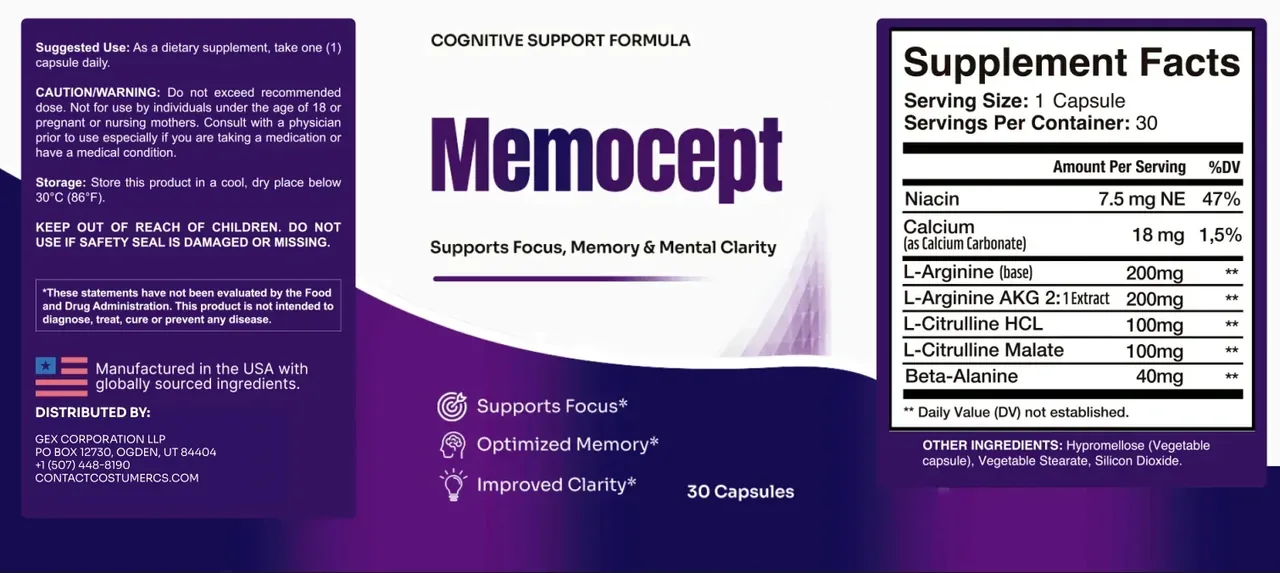
Why “not published” changes how you should read every Memocept row below
Under 21 CFR 101.36, a manufacturer must name what it puts in a supplement, but a proprietary formula need not disclose the individual amounts. the FDA labeling guide sets out the same rule. It is legal and it is extremely common.
It also means that when you read “contains L-citrulline”, you cannot tell whether that is 500 mg or 5 mg. What you can do is compare against the doses used in the research, and against the physical limit of the format: a large 00-size capsule holds roughly 700–900 mg of powder in total, and this one is splitting that across seven ingredients plus excipients.
Set that beside the trials — citrulline at 3–9 g a day, beta-alanine at 4–6 g, calcium’s daily requirement at 1,000 mg — and the arithmetic answers itself. These ingredients are present. They are not present at studied doses, and they cannot be.
So each entry below gives you two things: what the research found, and what dose it used. Where the answer is “this capsule cannot be delivering that”, the entry says so.
Every named Memocept active, with its evidence and its dose
Niacin
Amount not publishedVitamin B3 · Vitamin
One of two micronutrients on the panel, and the one most likely to produce a sensation you can actually feel. Niacin is an essential B vitamin required for the NAD and NADP coenzymes that run energy metabolism in every cell, brain cells included. Evidence: the NIH Office of Dietary Supplements maintains the reference intakes — 16 mg NE a day for adult men, 14 mg for adult women — and sets a tolerable upper intake of 35 mg a day for the supplemental forms, above which flushing becomes common. The caveat that matters: niacin corrects a deficiency. In the United States, frank niacin deficiency is rare. If you already get enough from food, more will not sharpen your memory, and the evidence that supplemental niacin improves cognition in replete adults is not there. The flush is real: two of the reviews on this website mention a warm flush in the first week, one of them solving it by taking the capsule with food. That is the classic nicotinic-acid response — harmless, uncomfortable, and worth expecting.
Sources: NIH Office of Dietary Supplements
Calcium
Amount not publishedEssential mineral · Mineral
The second micronutrient, and the one with the least to do with the product’s marketing. Calcium is structural — bone and teeth hold about 99% of it — and the remainder does real work in nerve signalling, muscle contraction and vascular tone. Evidence: the NIH Office of Dietary Supplements sets the adult recommended intake at 1,000–1,200 mg a day and the upper limit at 2,000–2,500 mg. Say the quiet part: a single capsule cannot carry a meaningful fraction of a 1,000 mg requirement alongside six other actives. Whatever calcium is here is a small contribution to a large daily number, and it is not the reason to buy this product. If you are taking Memocept for calcium, buy calcium.
Sources: NIH Office of Dietary Supplements
L-Arginine
Amount not publishedAmino acid · Amino acid
The first of four amino acids on the panel that share one mechanism: nitric oxide. Arginine is the direct substrate that nitric oxide synthase converts into NO, the signalling molecule that relaxes blood vessel walls and increases blood flow. Evidence: the pathway itself is textbook physiology and not in dispute. What is disputed is oral arginine’s efficiency — a 2008 pharmacokinetic study showed that oral L-arginine raises plasma arginine less reliably than L-citrulline does, because a large fraction is destroyed by arginase in the gut and liver before it ever reaches circulation. Which is why the panel also carries citrulline. That is a sensible formulation choice, and we will give the manufacturer credit for it.
L-Arginine AKG 2:1
Amount not publishedArginine alpha-ketoglutarate · Amino acid
Arginine bound to alpha-ketoglutarate in a 2:1 ratio — a form popularised by pre-workout supplements on the argument that it survives digestion better than free arginine. Evidence, stated plainly: that argument has not been well supported in humans. AAKG has been studied mostly in exercise settings, results are inconsistent, and we could not find controlled human evidence that arginine AKG improves memory, attention or any other cognitive measure. What it is doing here: adding a second arginine source to the same nitric-oxide route. It is a formulation preference, not an independent mechanism.
L-Citrulline HCl
Amount not publishedAmino acid · Amino acid
The better-evidenced half of the nitric-oxide story. Citrulline bypasses the gut and liver arginase that limits oral arginine, is converted to arginine in the kidney, and therefore raises plasma arginine more effectively than arginine itself. Evidence: a 2008 pharmacokinetic study demonstrated exactly that pharmacokinetic advantage. A 2019 meta-analysis of citrulline trials found reductions in blood pressure, and a 2016 crossover trial reported a 1.5% improvement in cycling time trial performance. The dose problem: those trials used 3 to 9 grams a day. The cycling trial used 2.4 g daily plus 2.4 g before the test. A single capsule holding seven actives cannot approach that — a whole 00-size capsule tops out under a gram. This ingredient is on the label at a fraction of any studied amount.
Sources: Schwedhelm 2008 pharmacokinetic study · 2019 systematic review and meta-analysis · 2016 crossover trial
L-Citrulline Malate
Amount not publishedAmino acid + malic acid · Amino acid
Citrulline paired with malic acid, a Krebs-cycle intermediate. The pairing is standard in sports nutrition, where it is used at 6–8 g a serving for muscular endurance. Evidence: the citrulline half is covered above. The malate half is proposed to support aerobic energy production, with human evidence that is thin and mostly ergogenic rather than cognitive. The pattern by now should be obvious: this is the fourth active on a seven-ingredient panel aimed at the same blood-flow pathway, all of them at amounts far below the doses their research used.
Sources: 2016 crossover trial
Beta-Alanine
Amount not publishedAmino acid · Amino acid
The ingredient a few buyers will notice within an hour, for reasons unrelated to cognition. Evidence: the ISSN position stand on beta-alanine is unambiguous — 4 to 6 g a day for at least two to four weeks raises muscle carnosine and improves performance in efforts lasting one to four minutes. On cognition specifically, an exploratory 2015 study looked directly at brain carnosine and cognitive function and did not find the clear effect the marketing of this ingredient class implies. The tingle: paraesthesia — a harmless prickling in the face, neck and hands — typically begins above roughly 0.8 g in a single dose. One reviewer on this website reports exactly that, once, then never again. Read that as information: if you feel a tingle from one capsule, the beta-alanine content is meaningful. If you feel nothing, it is likely well under 0.8 g — and so, by extension, well under the 4–6 g the research uses.
Sources: ISSN position stand · 2015 exploratory study
Every page, every journal post, the bottle facts and the ingredients go through review by Dr. Patricia McKeon before they ship. We write these pages from the Memocept label and the manufacturer’s own lot paperwork, cite public nutrient references for every named active, and print “not published” wherever a figure is not disclosed rather than estimating it. Where an ingredient’s evidence sits in a different field from the one it is being sold for, we say so. Corrections are made on the page itself and the review date moves forward — write to [email protected]. Last reviewed September 2026 by Dr. Patricia McKeon.
Memocept references
- National Institutes of Health, Office of Dietary Supplements. Niacin: fact sheet for health professionals. https://ods.od.nih.gov/factsheets/Niacin-HealthProfessional/
- National Institutes of Health, Office of Dietary Supplements. Calcium: fact sheet for health professionals. https://ods.od.nih.gov/factsheets/Calcium-HealthProfessional/
- Schwedhelm E, Maas R, Freese R, et al. Pharmacokinetic and pharmacodynamic properties of oral L-citrulline and L-arginine: impact on nitric oxide metabolism. British Journal of Clinical Pharmacology. 2008. https://www.ncbi.nlm.nih.gov/pmc/articles/PMC2291275/
- Barkhidarian B, Khorshidi M, Shab-Bidar S, Hashemi B. Effects of L-citrulline supplementation on blood pressure: a systematic review and meta-analysis. Avicenna Journal of Phytomedicine. 2019. https://www.ncbi.nlm.nih.gov/pmc/articles/PMC6369322/
- Suzuki T, Morita M, Kobayashi Y, Kamimura A. Oral L-citrulline supplementation enhances cycling time trial performance in healthy trained men: double-blind randomized placebo-controlled 2-way crossover study. Journal of the International Society of Sports Nutrition. 2016. https://www.ncbi.nlm.nih.gov/pmc/articles/PMC4759860/
- Trexler ET, Smith-Ryan AE, Stout JR, et al. International Society of Sports Nutrition position stand: beta-alanine. Journal of the International Society of Sports Nutrition. 2015. https://www.ncbi.nlm.nih.gov/pmc/articles/PMC4501114/
- Solis MY, Cooper S, Hobson RM, et al. Effects of beta-alanine supplementation on brain homocarnosine/carnosine signal and cognitive function: an exploratory study. PLoS ONE. 2015. https://www.ncbi.nlm.nih.gov/pmc/articles/PMC4397072/
- National Institute on Aging. Cognitive health and older adults. https://www.nia.nih.gov/health/brain-health/cognitive-health-and-older-adults
- National Center for Complementary and Integrative Health. Dietary supplements and cognitive function, dementia, and Alzheimer's disease: what the science says. https://www.nccih.nih.gov/health/providers/digest/dietary-supplements-and-cognitive-function-dementia-and-alzheimers-disease-science
- National Institute on Aging. What do we know about diet and prevention of Alzheimer's disease? https://www.nia.nih.gov/health/alzheimers-and-dementia/what-do-we-know-about-diet-and-prevention-alzheimers-disease
- U.S. Government Publishing Office, eCFR. 21 CFR 101.36 — Nutrition labeling of dietary supplements. https://www.ecfr.gov/current/title-21/chapter-I/subchapter-B/part-101/subpart-C/section-101.36
- U.S. Food and Drug Administration. Dietary supplement labeling guide: Chapter IV, nutrition labeling. https://www.fda.gov/food/dietary-supplements-guidance-documents-regulatory-information/dietary-supplement-labeling-guide-chapter-iv-nutrition-labeling
- U.S. Food and Drug Administration. Questions and answers on dietary supplements. https://www.fda.gov/food/information-consumers-using-dietary-supplements/questions-and-answers-dietary-supplements
- National Center for Complementary and Integrative Health. Dietary and herbal supplements. https://www.nccih.nih.gov/health/dietary-and-herbal-supplements
- National Institutes of Health, Office of Dietary Supplements. Dietary supplements: what you need to know. https://ods.od.nih.gov/factsheets/WYNTK-Consumer/
The Memocept panel is what it is. Now decide.
Seven named actives, no published amounts, no stimulants, and a capsule you either keep taking or you do not. Sixty days is long enough to find out.
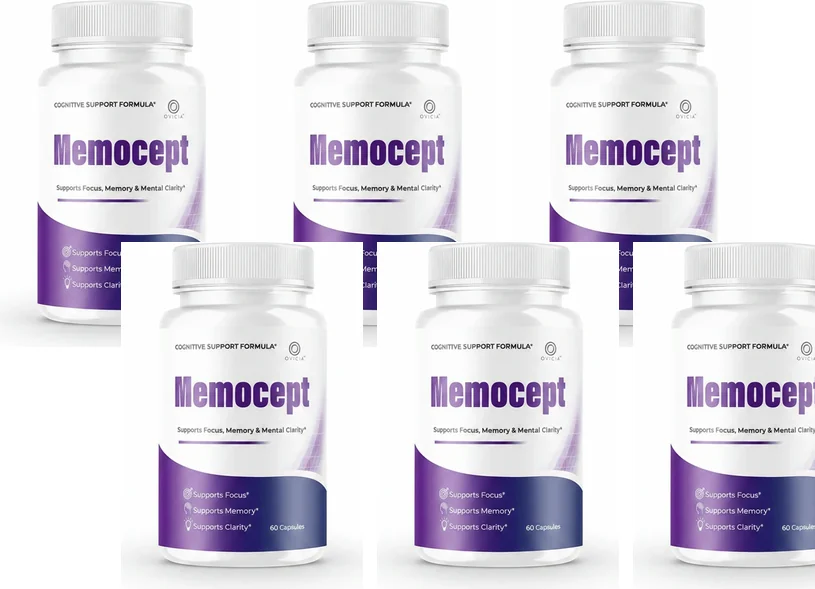
$294 — six bottles at $49 each
Order Memocept On The Official WebsiteFree US shipping · digital bonuses · 60-day money-back guarantee · lot MC26-NY5512